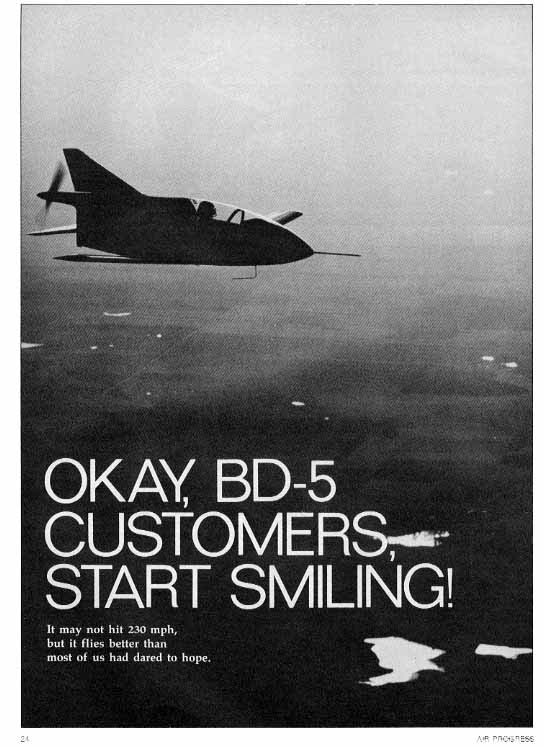
Okay all you skeptics out there (and I was one of the strongest), let
it be known here and not that, not only does the BD-5 fly, but about
90 per cent of us owe Jim Bede a gigantic apology. He has managed to
build a tiny little wing stability platform that shows more thought ingenuity
and out and out genius than anything general aviation has seen for years.
It still has some bugs to iron out in the engine department but, other
wise, the BD-5 , as we flew it, represents the first quantum leap forward
in light aircraft design since WWII. As I was hoisting my fanny up out
of the little cockpit after flying it, all I could think of was, "Jim
Bede, I'm sorry for all those rotten things I said about you and your
airplane." He's made a believer out of me.
You have to be a yak-herder in the Himalaya boonies not to know the saga
of the BD-5 by heart. Every magazine with a circulation of more than
15 has run at least one story about the BD-5 and its rotund, hyperactive
designer-builder-promoter, Jim Bede, and therein may lie one of the original
seeds of the great Bede controversy, as it now rages. Too much was said
too early in the game, promises were made, performance figures quoted
and money taken. So, when things didn't go like clockwork, the BD buying
public got a little bit ticked off (Witness the lynch mobs lurking in
dark corners at Oshkosh, lying in wait for him.).
There is no doubt that many early Bede claims were optimistic. No they
were more than optimistic, they were outlandish (270 mph was promised
at one point).
I sat in the bleachers with the rest of the aviation community and watched
the whole Bede experience develop. I booed and hissed right along with
the others. I can clearly remember receiving a three-view of the very
early Micro and my first impression was that Jim Bede was absolutely
and irrevocably out of his tree. The entire thing just wasn't possible.
All of us sidewalk engineers gawked at the early V-tailed fiberglass
prototype and nodded knowingly. It was generally agreed that, if it did
fly, it would have the inherent stability of a bongo board and the handling
characteristics of a Whiffle ball.
After a while the old "it will never fly" crowd changed their
tune to "it may fly but only a NASA test pilot can handle it," You
see, we had to find something else to gripe about because that chainsaw
with wings was flitting around at far too many airshows for us to maintain
credibility in the face of fact. It did fly and appeared to fly well.
Naturally, there is only one way to find out if "Joe average pilot" can
fly it and that is to snuggle down into it and go aviating, so we asked, "Can
we fly your airplane?"
The answer was, "of course."
First Bede had to check a few
things out. Next month maybe. When it was next month, the answer was
in a few weeks, then it went back up to months. This went on for over
two years. It looked like a classic holding action against a press that
might leak the news that the BD-5 was nothing more than a cylindrical
coffin with retractable handles.
At Oshkosh the word came down: we could come down to Newton and fly his
airplane at our convenience. At our convenience, really? We didn't
begin getting excited until we called him and he said,
"Sure, how about tomorrow?"
The second I stepped off the plane at Wichita, I knew it was trouble.
It was blowing about 35 knots in the middle of the night. They were probably
chaining the cattle to the ground. The next morning Les Bervin, BD test
pilot, confirmed our suspicions and allowed as how it wasn't the best
day to be flying the BD-5 for the first time, but it was okay to fly
the BD-5T trainer.
Their two-ton Tinker-Toy trainer is almost as ingenious
as the BD-5 itself. Using a systems of springs and booms, they have hung
a clapped-out BD-5 (early victim of a journey through a ditch) on the
front bumper of a Dodge pick-up truck. The springs counterbalance the
weight of the boom almost exactly, so any lift generated by those ridiculous
little wing panels will lift it off the ground and let you shoot touch-and-goes
and make gentle turns to your heart's content.
Looking at the truck, the airframe and the rail-straight windsock, I
suggested we draw straws. I lost. The other two guys locked themselves
in the truck cab, leaving me to be the first to find out what a Dodge-powered
BD-5 was like. Rich strapped me into the trainer and explained rotation
speeds and offered a few helpful hints as he was putting the headset
down over my twitching ears.
My first flight in the trainer was sort of hop, jiggle, bounce, scrub.
I over-corrected, over-rotated and over-wound just about everything.
The side stick initially seemed incredibly sensitive, then, magically,
about half way down the runway things seemed to smooth out. The second
run had me hopping off the ground like a frog on a hot rock, but by concentrating
on the runway in front of me and forgetting where my hand was resting,
I could even keep the wing down and cancel out the crosswind, which by
this time was a solid 40 knots. The third time around I rotated off almost
like a normal airplane. I was flying big gentle S-turns all the way down
the runway while I called out my height to Rich in the cab to see how
close I was. The fourth run was unnecessary; I felt like I knew what
I was doing. The rest of the guys had very nearly the same reaction.
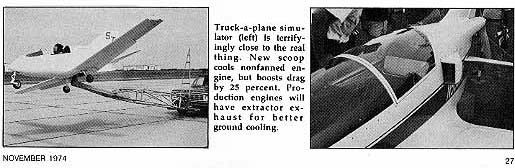 |
| If Jim Bede had any sense, he'd forget about
airplanes and market these trainersas grown-up circus rides. What
a kick! |
What the BD-Dodge combination showed me was, first of
all, takeoff happens very quickly and it is easy to over-rotate. then
it was even easier to over-rotate the rotation, which caused a little
bit of saw-toothed flight for a while. The most important thing I learned
was that by focusing my eyes straight ahead and flying it like one of
those fly-by-wire games in the bus depot, I could eliminate most of my
over-controlling difficulties. It is strictly a visual affair because
there is absolutely no feel or pressure in the control stick.
We each
had a chance to look through the flight manual, but Les sat us all down
and went methodically down the list so each of us knew what to do when.
Besides all the usual numbers, there were a few things I found even more
important to remember. The first was, if the engine quit, we couldn't
restart it. This particular bird had the starter ring gear removed and
they had to fire it up with a pull-cord. Also, the clutch and the drive
system is such that the prop freewheels when the engine isn't running.
Even though the prop is turning, the engine isn't. That didn't sound
too bad, but then he mentioned that if we touched zero G for even a second,
the float-type carburetor they had temporarily installed would choke
the engine deader than a mackerel. Well, if nothing else, I realized
that kind of information would make me tiptoe around while doing aerobatics.
There aren't a whole lot of airplanes around in which you can actually
retract the landing gear while sitting on the ground for cockpit check,
but then, there aren't too many airplanes six guys can pick up and
put on sawhorses either. That is where we sat while familiarizing ourselves
with the cockpit.
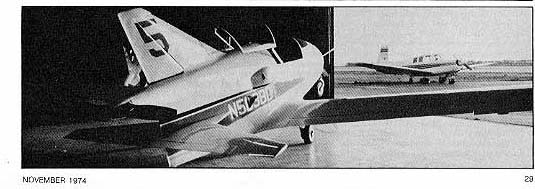
From the instant I stiff-legged myself down into
the cavern underneath the panel I was knocked out by the logic of the
cockpit. Everything is in the right place, easy to use and figure out.
The fuel controls are ahead of the left console and all the electrical
stuff-mags, master, etc. on the right one. The landing gear is a healthy
looking T-handle affair that would look more at home in a jacked-up
GTO. It juts up between your legs about where the control stick should
be and the flap handle is right next to it. The control stick is shaped
like a hot Baby Ruth you had squeezed in your hand, and sticks up out
the right console. Only the trim, which is right next to the throttle,
and the stick appears or feels anything but perfectly placed.
Once up on the sawhorses, we amused ourselves with the landing gear.
It takes a healthy tug to get it started up, but more than that, you
have to keep it moving so the inertia of the gear helps to get the
handle over center. If you don't keep your shoulder behind it, it will
stop halfway and you'll never get it up. When you pull, and keep on
pulling, you are rewarded (or surprised) with a healthy whack on the
bottom of the fuselage. There is absolutely no doubt that the gear
is up or down. When it slams into position, the airplane practically
jumps off of the sawhorses. It's like being inside of a giant switchblade.
Les had us do it without moving the stick so we wouldn't be jumping
around in the air when retracting the gear. It was good practice, but,
in my case, it didn't work.
We figured the way to beat the wind was to get up before it did, which
still didn't work. At 5:30 the next morning, with my eyes clamped shut
to keep my precious bodily fluids from leaking out, I staggered to the
door to see that it was still blowing up a mini-storm outside. We thought
we'd had it, but Les stuck a finger into the breeze and said, "Roll
it out; let's go flying."
A few minutes later I found myself fiddling with chokes, mixtures and
mags and hopping over expansion joints in the taxiway as I wended my
way down to the runway. In taxiing, the engine idled at nearly 3000 rpm;
it sounded like a lawnmower trying to run me down. I pressed the transmit
button on the top of the throttle and said, "I'm ready to go." My
headphones answered, '"Good-bye."
Looking back at it, I'll have to admit to not remembering
much about that take-off because it all happened so quickly. The engine
revved to about 5000 rpm immediately and the 52 hp behind me started
kicking me down the runway at an astonishing rate. At 50 mph I started
picking up the nosewheel, which skipped a couple of times; as I rocketed
to 60-65 I was up and away. The take-off was almost toy-like. I bobbed
around a bit, more from surprise than from anything else. As soon as
I started watching what I was doing and got out of ground turbulence
at 10 feet, it settled down and felt almost as solid as a Cessna 150
would have in the same wind.
At around 75-80 I reached down for the landing
gear, completely forgetting the keep-on-pullin' retraction technique.
I gave it a cursory jerk. As the handle came to a halt in the midway
position, I called myself a few choice names and rammed it forward
to lock it down again. While I was busy jamming the gear handle, I
forgot where my right hand was and unconsciously tweaked the stick.
This caused the airplane to jump around. When I gave the gear a healthy
pull it obediently leaped into the wells. As the gear came up and I
let the flaps up slowly, the speed wrapped up to 100 mph pronto.
The best-rate-of-climb speed was 90 mph, but I was keeping
it at around 100 for cooling. We climbed 1200 feet per minute with 52
hp blatting away behind, the tach working its way up to 6500 rpm and
the 182 camera plane disappearing fast.
The most surprising thing about those first few minutes of flight is
that everything seemed so normal. I didn't even bother to look out at
those tooth-pick wings or marvel at the incredible visibility. It just
felt that was the way airplanes should be: this was an airplane and it
just flew like one. I wanted it to feel strange and exotic, but things
fit together too well.
Set your hand on the chair next to you right now and make a fist. Now
wiggle it left-to-right while keeping your elbow stuck to the chair.
If you don't move the top of our fist more than half an inch or so, you'll
see what it is like to fly a BD-5. There is no noticeable resistance
and practically no movement of the stick. If you twitch your hand an
inch to the side, you've just done a roll. Move it an inch or so back
and you loop. Now, that sounds like it's sensitive, but for some reason
or another it doesn't work out that way. It's got to be the most natural
way to shepherd an airplane around I have ever seen.
Les had sworn that the stalls were nothing to write
books about and he was right. In any configuration it would shake, buffet,
leap and groan as you crept up to the stall, One wing would unload as
it would roll off in one direction of the other. I'd keep the stick completely
back and porpoise ahead, using aileron and rudder to keep everything
square with the world. The instant-I mean the very instant-the elevator
was released, the little beastie would be flying again. Clean it was
stalling at about 65, and dirty at about 55.
I cursed the zero-G carburetor as I sucked the nose up and tweaked my
hand left to watch the sky and ground swap places. With just a little
inverted capability–just a couple of seconds–you could drag the rolls
out into long, sensuous affairs over which you'd have infinite control.
I'll have to wangle another flight when they put the new carburetor on,
I guess. you can roll fast or you can roll slow, four points or eight,
left or right, and barely move your hand.
To the right, rolls are just
a little more difficult, because your wrist works more naturally inboard
than it does outboard. Full aileron deflection is only about a 2-inch
twist of your wrist, but you almost never need it. The roll rate is fast,
about 150 degrees per second, which is just a tad slower than a roundwing
Pitts. I can't begin to describe the total precision of these controls.
They don't even come close to being sensitive, but they put more control
in the palm of your hand than any other airplane I've flown.
Now, almost nobody reading this is going to believe
my next statement, yet it's absolutely true: the BD-5 is one of the most
stable little airplanes flying. When I'd set it up hands-off and then
pulse the stick–just bash it forward or back–the nose would come up and
then–bam–come back to level and not move again. There was almost no sign
of oscillations of any kind. The same if true of yaw: punch rudder,
and the nose snaps back as soon as you let go. In roll it seems just
a little more neutral. The wings stay pretty much where you put them.
I tested all this stability out by grooving around for a while while
I used both hands to adjust my headset and boom mike to eliminate some
communications problems (which turned out to be my inability to read "volume"
one the radio face).
The BD-5's high thrust line means a nose-down pitch with power. (the
nose comes up when you back off the throttle). Speed and power changes
do give a fair amount of trim change, but I had been flying for a while
before I noticed that I had been unconsciously moving the trim control
with the thumb of my throttle hand all along.
I knew Bede had done complete spin tests and Les had told us to go ahead
and spin it, but I'll admit that I put spins off until I worked up my
nerve. Finally, I got the power back, got the stick back, and kicked
rudder as it stalled. Instantaneously it snapped over on its back and
twisted downward into a near-vertical spin. the first turn was more of
a snap roll, the second turn was very oscillatory, with the nose coming
up fairly high. Then the nose dropped to about 60 degrees and stabilized
in a very fast spin. Sixty degrees, by the way, looks like you're going
straight down.
Les had said that the airplane had a distinct stick-free
spin mode, here the reduced drag of neutralized controls caused the speed
to increase and the spin to wrap up very tight. That's why it needs a
classic NACA spin recovery: bash the stick well forward and nail opposite
rudder hard.
Naturally, I managed to botch up the recovery. I moved the stick forward
too slowly at the end of three turns, and it immediately cracked around
in two more lightning-fast turns before I got the stick far enough
forward. I recovered in less than half a turn, going absolutely straight
down. I instinctively loaded a slight positive G on it to keep that
carburetor happy, and, in so doing, got a slight secondary spin in
the other direction. But that topped almost immediately. the second
time I spun it, I did what Les had told me to do, and it popped out
instantly. It's a very predictable-spinning airplane, but you have
to move like you mean business to stop it where you want it.
On the way back into the pattern, I made a couple of speed runs at 5,000
feet AGL. (9,000 feet density altitude for that day). I was showing an
even 155 mph cruise, and that works out to 177. Later, Peter did the
same thing down lower, at 1,000 feet, and got a solid 175 mph indicated,
which works out to 188.
I knew I couldn't stay up all day and avoid the landing. I flew a wide
360-degree overhead pattern, coming downwind at 100 mph and base at
90. It had taken me forever to get into the pattern, because power
off, at 85 mph, I was only showing about 380 fpm descent. I was beginning
to wonder about getting down before lunch. Les had said the gear worked
like spoilers, and when I dropped it, I saw what he meant. With gear
and flaps down I had to use just a tad of power to fight the wind as
I turned final for the taxiway we were using the land. (It was smoother
than the runway.)
The pitch stability came in handy for holding 85 right
on the money as I jockeyed the power just a little to stay on glide path.
I kept reminding myself what the view over the nose in the trainer had
looked like as I came closer to the ground. The wind tried to goggle
me around but a tweak here and a tweak there kept everything perfectly
lined up.
As the pavement started to get closer, I gently (very gently)
started to flare. The second I moved the nose, the airplane stopped coming
down. So, I relaxed a bit and started feeling for the ground. Lower.
Lower. Lower. Suddenly I knew I was only a foot or so off and I started
a game with the wind. I tried to hold the airplane up as the wind tried
to bat me around. Plunk, and the mains were on. I tried to hold the nose
gear up, but the flaps were too much for it and it dropped onto the pavement
anyway. We were on the ground at around 60 mph. The roll out was easy
to control with the rudder and I didn't need to use the brake at all
until I was ready to turn into the parking area.
Well, I think we've discovered what kind of pilot it takes to fly the
BD-5. Any proficient 150-hour pilot could learn to handle it, but only
if he had already developed certain skills and mental attitudes. He'd
better be an accurate pilot. He can't make vague, unmetered control
movements or be only fuzzily aware of what he sees over the nose. The
airplane is capable of absolute precision, and to make consistently
smooth landings and takeoffs, the pilot must use that precision. Most
pilots are sloppy; they'll have to de-slop themselves before the fly
the Five. The guy who takes great pride in making nothing but squeakers
right on the centerline won't have any trouble at all. This type of
mental attitude is totally independent of flight time, and can be present
or absent regardless of how fat or skinny the logbook may be.
Flying the trainer would be the best bet for transitioning into the Bede.
There you get the super-low ground attitude, seating position, and control
response all in one package. Otherwise a glider–especially something
like a Blanik or a 1-34–will give you a perfect learning situation for
the supine seat and ground-hugging landing attitude. An older Yankee
would give you the basic control responses, the brake-only directional
control, and similar stall characteristics., (the BD-5's are far better.)
Asked how I feel about it, I can only say that now I
wish I hadn't let my skepticism keep me from putting down my $400 deposit
for a production model. Oh, well . . . Bede probably has something else
up his sleeve, and you can bet I'll put my money where my doubts are
this time.
|